


To see better when cycling at night, you need the right light at the front, a speed that matches how far the beam reaches, and a route you already know. Being seen is a separate job, done by a steady rear light, reflectors and where you ride on the road. Get those four things right and riding in the dark becomes calm and predictable. That is why we fit integrated LED lighting to our folding Pony bikes: the lights are part of the bike, so they are there on every ride.
TL;DR
- In the UK, between sunset and sunrise you need a white front light, a red rear light, a red rear reflector and amber pedal reflectors.
- To see the road on unlit routes, aim for a front beam that lights at least 15 metres ahead, and slow down until you can stop within the distance you can see.
- Use a steady front light. At the back, a steady light or a pulse mode that never goes fully dark is the safest choice on unlit roads.
- Moving reflective items, such as ankle bands, do more than bright clothing alone.
- Ride a familiar, well-lit route first, carry spare batteries, and build up to busier roads gradually.
Table of Contents
- Seeing the road and being seen are two different problems
- What the law requires in Britain
- How bright should your front light be?
- Steady or flashing?
- Where to put your lights
- Match your speed to your beam
- Be seen: reflectors, clothing and signals
- Where to ride on the road
- Choose your route, then build up gradually
- A two-minute check before every night ride
- Wet, cold and slippery nights
- Perspective
- A Pony for the dark months
- FAQ
- Sources
Seeing the road and being seen are two different problems
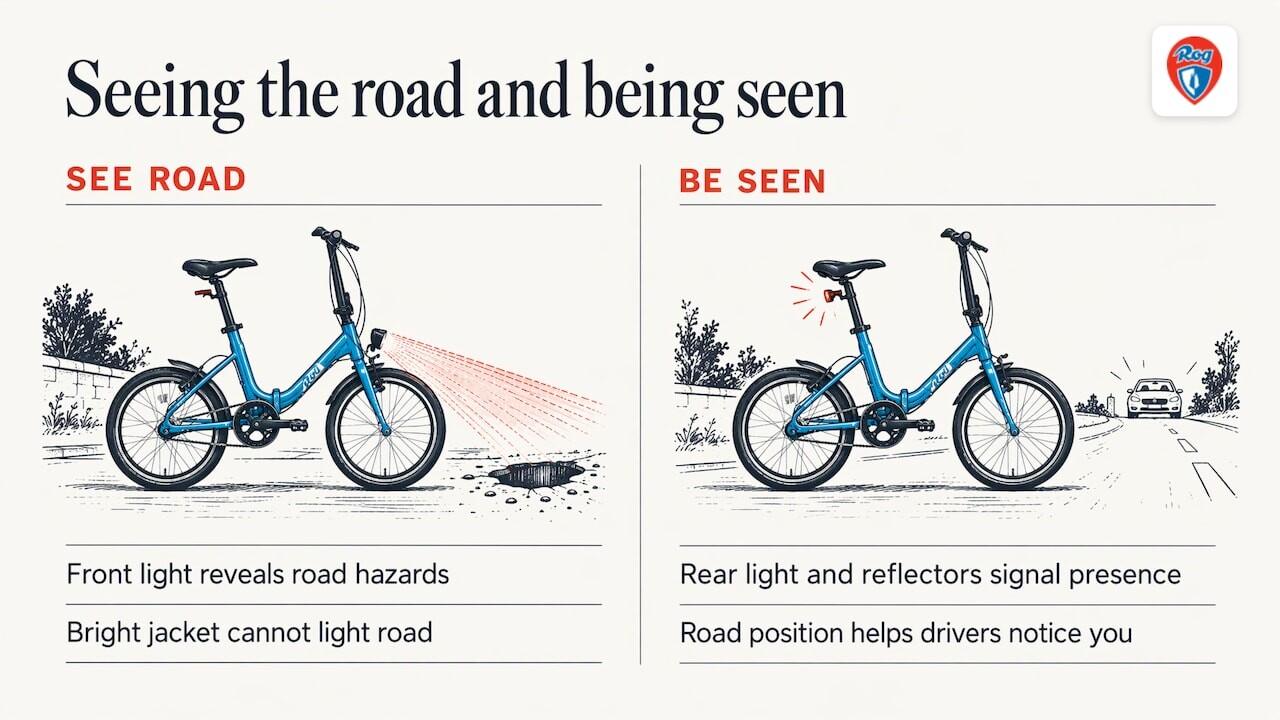
Most advice on night cycling blurs two things together. The first is your own vision: can you spot the pothole, the drain cover or the wet leaves in time? The second is other people’s vision of you: does the driver at the junction register that you exist?
The front light solves the first problem and helps with the second. The rear light, reflectors and your position on the road mostly solve the second. A strong front lamp will not make a driver behind you notice you, and a bright jacket will not light the road surface.
The health guidance is reassuring on one point. Healthdirect, Australia’s government health information service, says cycling at night or in low light is generally safe when you have front and rear lights, a red rear reflector and bright clothing, and when you check your brakes and lights first. It also suggests riding the route in daylight first and telling someone where you are going.
What the law requires in Britain
The legal minimum is your starting point, not your target. Cycling UK states that between sunset and sunrise you must have:
- a white front light
- a red rear light
- a red rear reflector
- amber pedal reflectors
The front light should do more than make you visible. On unlit roads, Cycling UK says the beam should illuminate at least 15 metres ahead. Many riders forget the pedal reflectors, which are easy to lose or knock off. Check them at the same time as the lights.
The same guidance covers dazzle. Rule 114 of the Highway Code says lights must not dazzle or cause discomfort, and a high-power front light should be lowered when other road users are close. That matters more than it sounds. A very bright lamp aimed straight ahead can leave an oncoming driver or cyclist unable to see you at all.
How bright should your front light be?
Brightness is measured in lumens, a unit for the total light a lamp puts out. Cycling UK’s guide gives these rough ranges:
| Where you ride | Roughly what you need |
|---|---|
| Streets with good street lighting | 50 lumens or more is enough to be seen |
| Unlit roads at a steady pace | About 300 to 800 lumens |
| Off-road, in a wider spread | 1,000 lumens or more |
A city rider on lit streets does not need a mountain-bike floodlight. Cycling UK’s top tips author warns that a mountain-biking light will dazzle oncoming drivers on a road, and that piling on lights and hi-vis does not automatically make you more visible. Choose the light for the riding you actually do.
Lumens are only part of the picture. A research review from the SAE’s vulnerable road user group explains that how visible a light is depends on its intensity, the brightness of the background and the observer. A light that stands out on a dark country lane can disappear against a bright shopfront street. Beam shape matters too: a good beam spreads evenly, without a dark patch right where you are looking.

A worked example
Say you commute 6 miles through town, with the last 2 miles on an unlit towpath. Street lighting covers most of the trip, but the towpath is where you need to see. A front light in the 300 to 800 lumen band, lowered when you meet other people, handles both stretches. On the lit streets you can switch to a lower mode and save the battery. On the towpath you switch up and slow down.
Steady or flashing?
This is the question that splits cyclists. Flashing lights grab attention, but there is a cost. Cycling UK’s research-based guidance says flashing lights draw the eye more than steady ones but make it harder for drivers to judge distance and track movement. So it recommends:
- Front: a steady lamp. A flashing front light is of minimal use for seeing and can distract other road users.
- Rear on unlit roads: a steady light, or a pulse mode that never goes completely dark.
The SAE review backs this up. It reports that flashing can impair judging relative speed or distance and can make nearby pedestrians harder to detect.
In practice: steady at the front, steady or pulsing at the rear. If you want a second light for attention, add it as a backup, not as a replacement for the steady one. Two rear lights also give you cover if one fails.
Where to put your lights
Mount the front light on the handlebars where nothing blocks it: a basket, a bag or a coat hem can hide it completely. Point it down at the road, not at the eyes of oncoming traffic. Fit the rear light at the back of the bike or on the seatpost, or on a bag that does not swing about.
A few habits make a real difference:
- Check the beam angle after every time you bump or transport the bike. Lamps drift downward or upward without you noticing.
- Keep the rear light clear of mudguards, panniers and long coats.
- Wipe the lenses. Road spray leaves a film that dims them.
If you carry a lot on the bike or ride a folding model, check that nothing folds or hangs in front of a light once you are riding.
Match your speed to your beam
This is the part of night cycling that most guides skip, and it is the biggest single gain in what you can see in time. Cycling UK advises riding at a speed where you can stop within the distance your light shows you. It gives about 10 metres at 15 mph as a guide, and says you should allow double that or more in rain or when you are tired.
So if your light only shows you the road for a short way, slow down. Do not buy your way out of the problem with a brighter lamp and then ride faster. A brighter beam with the same speed gives you more time. A brighter beam with a faster speed gives you the same time as before.
Bikes with internal gear hubs make this easier. You can change gear while stopped, without any grinding, so you are not fiddling at a junction in the dark.
Be seen: reflectors, clothing and signals
Hi-vis clothing is the thing people reach for first. The evidence is less simple. Cycling UK says hi-vis makes little difference to how closely motorists overtake, but retro-reflective accessories are probably worth the investment, especially ankle straps that move as you pedal. Moving reflective points are very recognisable as a cyclist, because the up and down motion is unlike anything else on the road. The same page suggests reflective sleeve bands or gloves, and signalling with your arm fully extended.
So a sensible kit is:
- reflective ankle bands (moving, so they stand out)
- reflective bands or gloves for your arms, so signals show up
- a helmet, ideally with a reflective element
- pedal reflectors kept in place, as the law requires
We stock helmets, clothing and other cycling kit alongside our bikes, so you can sort the kit at the same time as the bike.
Where to ride on the road
Hugging the kerb feels safe, but it can make you harder to see. British Cycling’s advice for the clocks going back is to ride where drivers can see you. Staying tight to the side also leaves you little room to avoid drains and debris.
Cycling Ireland’s road guide frames the same principle: you should always be where other road users can clearly see you, and ride steadily. It describes taking the position that is safest, from the left of a wide, fast road to the middle of the lane on a narrow, winding one, to prevent dangerous overtaking.
At junctions, assume you have not been seen. Portland’s transportation department advises a defensive mindset in the dark, and using a bell, horn or your voice to catch a driver’s attention where a car from the side may not register your light. That advice is American, but the situation is the same at any British side road.
On oncoming full beams, Cycling UK suggests that, if it is safe, turning your handlebars gently from side to side can remind the driver to dip. Keep both hands ready to brake while you do it.
Choose your route, then build up gradually
Night riding gets easier with practice, and the first rides should be easy ones. British Cycling’s research found that 7% of people cycle less for weather-related reasons in winter, against 4% in summer, and that 12% of women describe winter cycling as dangerous, against 9% in summer. Its advice for new night riders is to:
- start on a familiar, well-lit route
- allow extra time
- move gradually from traffic-free circuits to busier roads
Cycling UK adds that you should stick to familiar routes and avoid unlit cycle tracks and underpasses at night. If you are unsure about a stretch, ride it once in daylight, as the Healthdirect and Cycling Scotland guidance both suggest. Riding with a friend or a group also helps. If you want company, a pre-ride checklist for group rides covers the quick checks worth doing before you set off after dark.
A two-minute check before every night ride
Batteries go flat, and mist or fog can roll in fast. Cycling UK advises carrying spare lights and batteries, because the clocks changing also means it gets dark earlier than you expect. Before you leave:
- Switch on both lights and check the beam points at the road.
- Look at the rear light from a few steps behind the bike.
- Press the brakes and check they grip.
- Confirm the pedal and rear reflectors are in place.
- Pack a spare light or fresh batteries, and a lock if you will be stopping.
- Tell someone your route if it is a long or new one.
A correctly fitted bike also helps you see better, because you can hold your head up and look ahead rather than hunch over the bars. Our bike fit basics explain how saddle and handlebar height should suit you.
Wet, cold and slippery nights
Rain cuts visibility for you and for drivers. Slow down further, as Cycling UK suggests, and double your stopping distance. Portland’s guidance recommends letting a little pressure out of your tyres for wet grip and crossing rails at 90 degrees. On icy British roads, Cycling Scotland notes you can fit studded tyres. Wet leaves and painted road markings are slippery, so brake before bends, not in them.
Perspective
We design the Pony as a bike for real city life: folding aluminium frame, stainless steel chain and spokes, internal gear hubs and a comfortable Selle San Remo or Brooks leather seat. Integrated LED lighting is part of that design, and for a night rider that matters, because lights that are built in are lights you always have with you.
What we have learned from the advice above is that night cycling comes down to a calm, upright, unhurried ride. An internal gear hub lets you change gear when stopped. A comfortable seat lets you sit tall and look ahead. A folding frame means the bike comes indoors with you at the end of the night, out of the damp and the cold.
We also sell helmets, clothing, locks, pumps and bags, so a rider can add the reflective and protective kit around the bike in one place.
the author
A Pony for the dark months
If you want a bike that suits short days, our Pony range combines a retro look with integrated LED lighting, internal gears and a foldable aluminium frame. The Pony range covers the single bike, the Pony Duo and the Touring models, including Touring for men and Rog Touring for women.
For the rest of your night kit, our accessories category has helmets, clothing, locks, pumps and bags, and the cycling equipment page has more.
FAQ
Is it safe to cycle at night?
It is generally safe when you are well prepared. Healthdirect advises front and rear lights, a red rear reflector, bright clothing and a check of brakes and lights before you go. Start on familiar, well-lit routes and build up gradually.
How many lumens do I need to see the road?
On unlit roads at a steady pace, Cycling UK suggests around 300 to 800 lumens, with a beam that lights at least 15 metres ahead. Under street lighting, 50 lumens or more is enough to be seen. Off-road you will probably want 1,000 lumens or more.
Should my bike lights flash?
Use a steady front light, as flashing front lights are of little use for seeing and can distract others. At the back, a steady light or a pulse mode that never goes fully dark is the better choice on unlit roads. Flashing makes it harder for drivers to judge your distance.
Does hi-vis clothing help at night?
Cycling UK says hi-vis makes little difference to how closely drivers pass, but reflective accessories are worth having. Moving reflective ankle bands are especially recognisable because of the pedalling motion.
Sources
- Cycling and your health, Healthdirect
- Light up the night: a guide to cycling in the dark, Cycling UK
- Top tips for cycling in the dark, Cycling UK
- Cycling at night: how to enjoy riding when the clocks go back, British Cycling
- Guide to cycling on the road, Cycling Ireland
- Lighting and visual information for vulnerable road user safety, SAE VRU Safety
- Tips for biking in the wet, cold, and dark, Portland.gov
- Essential Cycling Skills Quick Guide, Cycling Scotland


